Prepare a flavourful Gujarati Thali at home complete with authentic and traditional Gujarati recipes. In this guide, you will find recipes for Gujarati flat breads, Gujarati shaak , gujarati dals, pickles, and so much more!
Included is a recipe for Gujarati Chaas.
- What is a Thali?
- Gujarati Thali
- What is included in a Gujarati Thali Menu? Thali at a Gujarati Restaurant Everyday Gujarati Thali
- Gujarati Shaak
- Breads
- Dal / Kathol & Kadhi
- Rice
- Farsan
- Sundries
- Chutney or Pickle for Gujarati Thali
- Gujarati Sweets
- FAQs
In many Gujarati households, a traditional Gujarati thali is prepared daily.
Traditional Gujarati food is always pure vegetarian and some recipes are even naturally vegan. Pure vegetarian means that no eggs are used.
What is a Thali?
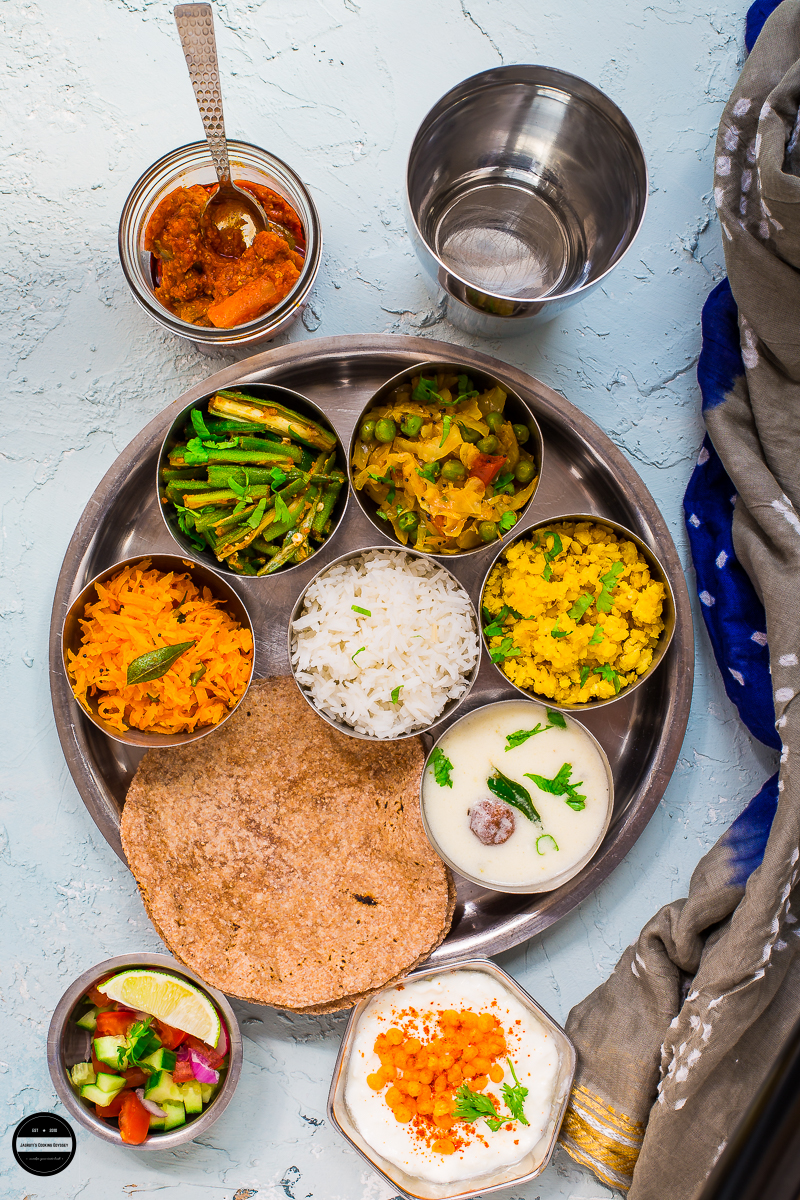
Thali translates to plate in Hindi or Gujarati. It’s a round stainless steel platter on which food is served, in small round steel bowls. Thali are served primarily for lunch or dinner.
You can serve the food in a proper thali, but a “thali” can also be used to describe a complete meal regardless of how it is served.
A typical thali consists of a flatbread, a curry, a lentil dish, a rice dish, a salad, a pickle and yogurt.
A thali is known to be well balanced with complex carbohydrates, vegetable dishes that are high in dietary fibre, lentils for protein and yogurt to provide healthy gut bacteria.
You can find thali in many cuisines within India. Notable ones include:
- Punjabi thali or North Indian Thali
- South Indian Thali
- Bengali Thali
- Indo-Chinese Thali
Thali like this are often served in Indian restaurants and are a great way to try out different dishes from the various cuisines.
Gujarati Thali
Gujarat is a state in Western India. Gujarati food has its own unique taste compared with food from around India.
The flavours are typically spicy, tangy, sweet. The sweetness comes from the use of a type of unrefined sugar – jaggery.
The spices used are commonly ginger and green chilies with the basic Indian spice powders. These are dry red chilli powder, turmeric powder, cumin coriander and garam masala.
In the tempering, mustard seeds or cumin seeds can be used. Curry leaves also make an appearance in various recipes.
In a Gujarati Thali, all food is served at once – the starter, main and dessert! It is also eaten together as well so that all the various flavours and textures can complement each other.
A Gujarati Thali contains all the macro nutrients that a body needs for one day.
You can get a few different types of Gujarati Thali – some are for everyday, and some are for events such as weddings or special occasions.
The differences are included in the post.
What is included in a Gujarati Thali Menu?
In a Gujarati thali, you will find a variety of authentic Gujarati dishes. Each thali is carefully prepared so that ingredients and flavours complement and balance each other.
You may have heard the words “dal bhaat shaak rotli”. This is essentially a daily style of Gujarati thali eaten in Gujarati homes.
Usually, Gujarati thali is served in a stainless steel plate with steel bowls with water or buttermilk (chaas) served in a steel glass too.
- Indian flatbreads – rotli, poori, thepla or puran poli are examples. Mostly, wholewheat atta or multigrain atta is used which is healthy and full of fibre.
- Gujarati curries – aka shaak or saak in Gujarati. These vegetarian curries are made with vegetables. These curries may contain garlic, especially if they are kathiyawadi recipes but onion is rarely used in Gujarati cooking. Examples include potato cabbage curry, aubergine (eggplant) and potato curry, ivy gourd curry, sev tomato curry, chickpea and potato curry, okra curry and so many more.
- Gujarati Kathol – In Gujarati, ‘Kathol’ translates to legumes/beans/pulses. Instead of vegetable curries, kathol recipes are made in replacement and served with kadhi.
- Gujarati Kadhi or Gujarati Dal – the daal and kadhi are never served at the same time – it is always one or the other.
- Stir fry or salad – carrot stir fry, cabbage stir fry or kachumber
- Raitu/raita or plain yogurt – boondi raita, cucumber raita or yogurt cools down the meal and boosts gut health
- Pickle or chutney – pickle is thought to aid in metabolism. Pickles can provide extra flavour to meals however, they tend to be oily and spicy. Some chutneys like green chutney are much healthier.
- Farsan – a snack or appetizer is sometimes included. Farsan includes khaman, patra, sev, kachori, gota and more.
- Plain boiled rice – plain boiled basmati rice is eaten along with the toor dal or kadhi
- Roasted papad
- Chaas or water
- Gujarati sweets – sweets include keri no raas, shrikhand, lapsi
Thali at a Gujarati Restaurant
Particularly in India, many restaurants serve thali as part of their menus. These thali are packed with many different curries, dals, farsan, breads and sweets!
In some places around India, or the Gujarat capital Ahmedabad, you can find restaurants serving unlimited Gujarati thalis. Here, your plate is continually topped up!
Everyday Gujarati Thali
In an everyday Gujarati thali that is prepared at home, it is unlikely that farsan and sweets are included. If my Mum or my Grandma makes a thali, they stick to one curry, either dal or kadhi, one salad and one flatbread.
Let’s get into the different food served in a Gujarati Thali:
Gujarati Shaak


Breads


Vedmi or Puran Poli – is a traditional Gujarati stuffed bread with a sweet lentil filling. We love to serve with Valor Ringna Nu Shaak and Gujarati Kadhi.


Bajra Na Rotla – prepared with pearl millet flour/bajra flour and are suitable for gluten-free diet. They are often prepared during the winter months.


Gujarati Thepla – made using wheat flour and basic spices without adding any vegetables. Can be served with mild curries, yogurt, pickle or Indian chai tea.


Dal / Kathol & Kadhi


Gujarati Bhinda Ni Kadhi – or Bhinda ni kadhi is a delicious and creamy, thick yogurt & chickpea flour based okra curry which is famous in the Gujarati Cuisine usually served with rotli, rotla or khichdi.
Rice
Plain boiled basmati rice known as Bhaat or sometimes Matar Bhat or jeera rice is served in Gujarati thali.


Khichdi – If khichdi is prepared, then kadhi will be prepared but not a protein such as dal because khichdi is already made from a mix of rice and dal.

Khichdi can be prepared with various lentils such as this Masoor Dal Khichdi.


Farsan
Farsan refers to a variety of savoury snacks specifically found in Gujarati cuisine.
In an everyday Gujarati thali, these would not be included but rather for special occasions or weddings.


Patra – Gujarati Patra is a popular vegetarian snack made from Colocasia leaves coated with a spiced gram flour batter, steamed, and then tempered with mustard seeds and sesame seeds. They are eaten as a snack or in thali as farsan.
Khaman – khaman is probably Gujarati cuisines flagship recipe! Spongy khaman are made from a gram flour batter then steamed. A tempering is poured on top the cooked khaman.
Sundries


Yogurt – yogurt or curd is always included whether homemade or store bought.
Chutney or Pickle for Gujarati Thali




Gujarati Sweets


Commonly, keri no ras is paired with poori. However, you can also dunk your rotli into the pulp as well!


Farali Gujarati Thali
Perfect for fasting for occasions in the Hindu or Gujarati calendar!
Farali Masala Poori – poori made with a farali flour


Palak Poori – poori made with farali flour with added fresh spinach! These taste as amazing as they look!
Farali Dudhi Thepla – Gujarati thepla prepared with bottle gourd.


Ratalu / Kand Sabji – this farali dish is made with purple yam, peanuts and basic spices.

Cassava Peanut Stir Fry – this East-African recipe is made with mogo and peanuts


Farali Rajgira Magas – this wonderful Gujarati sweet is made with amaranth flour.
The most famous food of Gujarat is undoubtedly Dhokla, a steamed savoury cake made from chickpea flour. It is soft, spongy with a tempering of mustard seeds and curry leaves. Another popular dish is Undhiyu , a curry made with a variety of seasonal vegetables, spices, and coconut. Thepla, a thin, spiced flatbread is another Gujarati favourite, often enjoyed with pickles or yogurt. Handvo, a savoury lentil and rice cake, is loved for its unique texture. Finally, Gujarati Kadhi, a tangy yogurt-based soup, is a comfort food staple in Gujarati households with rice or khichdi.
The staples of Gujarati food include rice, wheat flour, lentils (such as toor dal, moong dal, and chana dal), vegetables (such as okra, eggplant, and potatoes), yogurt, buttermilk, spices (such as cumin, coriander, turmeric, and mustard seeds), jaggery (unrefined cane sugar), and various oils and ghee (clarified butter) for cooking. These ingredients form the foundation for a wide range of Gujarati dishes, including rotli (Indian bread), dal (lentil soup), shaak (vegetable curries), kadhi (yogurt-based curry), and various snacks and sweets.
As always if you make this recipe, be sure to leave me a comment, rate this recipe and tag me on Instagram @jcookingodyssey or #jcookingodyssey. I love seeing all your photos of my recipe recreations!
Don’t forget to follow me on social media using the buttons below – I can’t wait to see you all there!
- YouTube

Gujarati Thali
Ingredients
For Chaas
- ½ cup yogurt choose plain yogurt
- 3 cup water adjust this to reach desired consistency
- 1 teaspoon cumin seeds roasted then crushed
- 1 tablespoon fresh mint and cilantro leaves finely chopped (optional)
- pinch salt to taste
Instructions
How to build a Complete Gujarati Thali
- Choose a flatbread
- Choose one or more shaak
- Next, select either dal, kathol or kadhi
- Choose a rice dish
- If making for a special occasion, go for a farsan
- Optionally, choose a pickle or chutney
- Pick a Gujarati sweet
How to make Chaas for Gujarati Thali
- In a jug, add in the yogurt of your choice. Using a spoon or wire whisk, whisk the yogurt gently until smooth.
- Add chilled water to thin out to your desired consistency. Note that Gujarati Chaas is thinner than Punjabi Lassi.
- Add crushed roasted cumin seeds and a small pinch of salt.
- Optionally, add in finely chopped or torn fresh cilantro (coriander) and/or mint leaves
- Add more water if required to thin out further.
- Serve immediately.
Video
Notes
Nutrition
PLEASE NOTE: Nutritional values are estimated by a computer and may vary based on ingredients and portion sizes. For personalised dietary advice, please consult a qualified healthcare professional.
Gujarati Thali
Ingredients
For Chaas
- ½ cup yogurt choose plain yogurt
- 3 cup water adjust this to reach desired consistency
- 1 teaspoon cumin seeds roasted then crushed
- 1 tablespoon fresh mint and cilantro leaves finely chopped (optional)
- pinch salt to taste
Instructions
How to build a Complete Gujarati Thali
- Choose a flatbread
- Choose one or more shaak
- Next, select either dal, kathol or kadhi
- Choose a rice dish
- If making for a special occasion, go for a farsan
- Optionally, choose a pickle or chutney
- Pick a Gujarati sweet
How to make Chaas for Gujarati Thali
- In a jug, add in the yogurt of your choice. Using a spoon or wire whisk, whisk the yogurt gently until smooth.
- Add chilled water to thin out to your desired consistency. Note that Gujarati Chaas is thinner than Punjabi Lassi.
- Add crushed roasted cumin seeds and a small pinch of salt.
- Optionally, add in finely chopped or torn fresh cilantro (coriander) and/or mint leaves
- Add more water if required to thin out further.
- Serve immediately.
Video
Notes
Nutrition
PLEASE NOTE: Nutritional values are estimated by a computer and may vary based on ingredients and portion sizes. For personalised dietary advice, please consult a qualified healthcare professional.
This particular cooling and refreshing drink is a tart and sweet fruity mix of hibiscus and rose flowers and basil seeds. This easy and fuss-free recipes can be done in a few ticks and leaves you plenty of time to enjoy the warmer weather.
Hibiscus flowers
I never knew anything about hibiscus flowers or it’s recipes and nutritional values until I saw them in Dubai spice market. I bought a packet of dried hibiscus flowers to bring home and they ended up in the back of the cupboard.
Once I searched recipes for hibiscus flowers online and read about its health benefits, I had a great excuse to make this natural and refreshing drink.
I have planned to make this amazing refreshing Vegan Watermelon Carpaccio Salad with Tahini .
Once I thought of making hibiscus sharbat, I added basil seeds aka Takmaria/Tukmaria or Sabja as these tiny but mighty seeds offers a bucketful of benefits. They act as a coolant and have a cooling effect on our bodies.
I prepared a pitcher of this natural, delicious and good for you Sharbat to cool off in this sweltering heat
Have you ever tried using hibiscus in your recipes? If not, I urge you to make this summer. Just find fresh hibiscus flowers or dried and make this sharbat in no time. If you want to make this drink for a get-together, make a hibiscus flower concentrate in advance, store it in the refrigerator and use it whenever you require
Notes:- I have used the dried hibiscus flowers, but you can use fresh too. I have used the rose syrup to sweetened the sharbat, you can use normal sugar, honey, or maple syrup too. This sharbat can be made without basil seeds too.

Rose Sharbat
Ingredients
- ¼ cup hibiscus
- 4 tablespoon rose syrup
- 1 tablespoon basil seeds
- ice
- 3 cup water
- mint to garnish
Instructions
- Place hibiscus petals and water in a saucepan.
- Bring the mixture to boil until flowers turn white and water ruby red.
- Meanwhile, in a small bowl soak the basil seeds in cold water.
- Turn off the heat and let the mixture cool.
- Strain the petals, add rose syrup to it and mix well.
- Now add bloomed basil seeds into the sharbat.
- In a serving glass pour the sharbat, top it up with ice and fresh mint.
Notes
PLEASE NOTE: Nutritional values are estimated by a computer and may vary based on ingredients and portion sizes. For personalised dietary advice, please consult a qualified healthcare professional.
