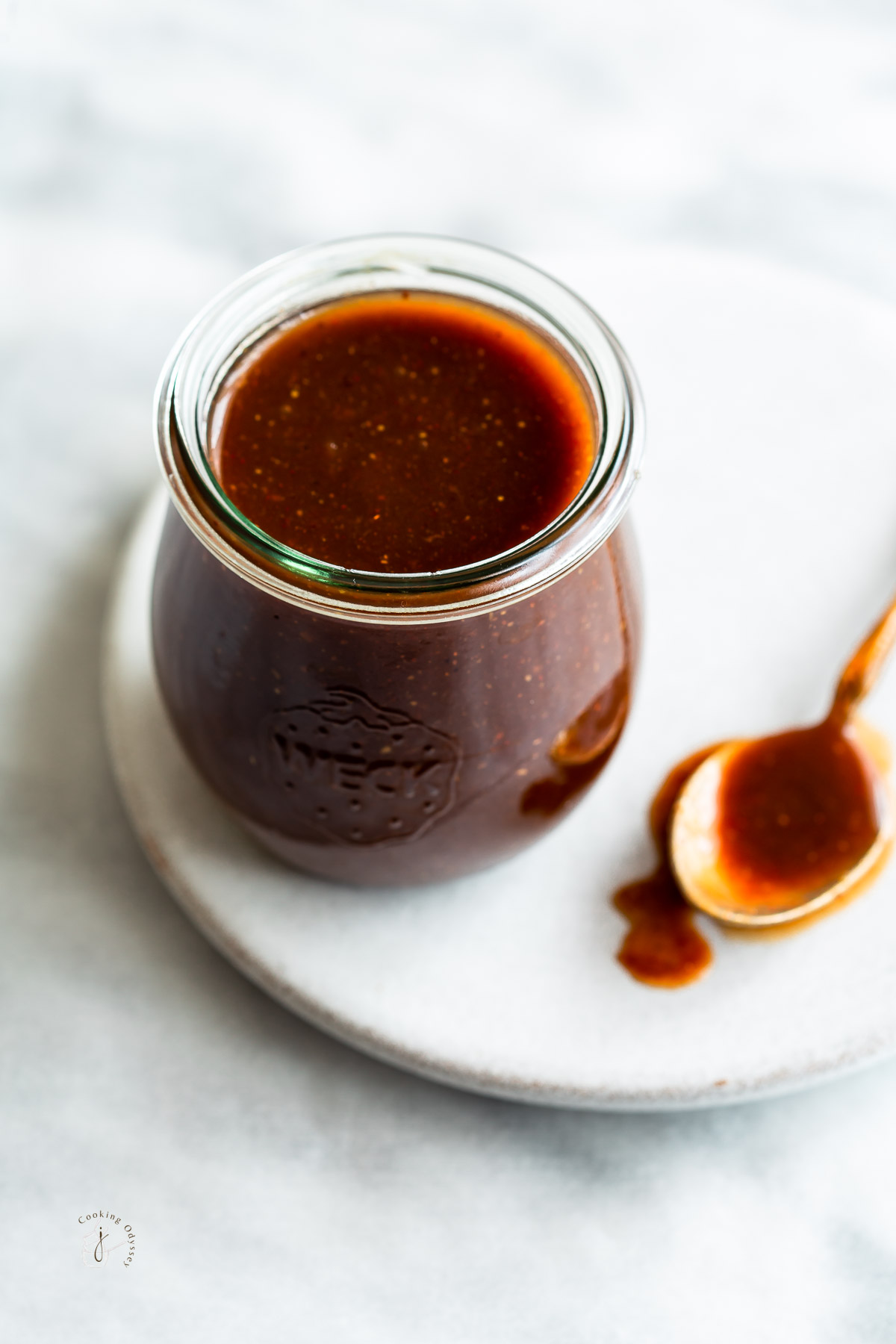
This Indian Tamarind Sauce recipe is just like the Sweet Tamarind Chutney served at Indian restaurants. It is made from tamarind, jaggery and basic Indian spices.
I love serving it alongside these poppadom dips and homemade poppadoms !
Naturally vegan, gluten-free and oil-free dip.

This Tamarind sauce is made from scratch and the recipe is so simple. Simply soak tamarind pulp, blend, sieve and add the flavourings! So easy! This is one of your vegan dipping sauce recipe.
There is something addictive about Indian dips with samosas, pakoras, bhajis and pappadums! I often prepare delicious sauces like Indian Onion Chutney , Indian Mint Sauce and red Garlic chutney with my Indian appetizers.

What is Tamarind Sauce?
Tamarind dipping sauce or Tamarind chutney is a sweet and sour condiment made from the fruit of the tamarind tree.
The Tamarind tree is native to Africa and Asia.
The tamarind fruit is first boiled until it becomes soft, and then the pulp is extracted and strained to remove the seeds and fibres.
The resulting paste is then combined with various other ingredients such as sugar, salt, chili powder, and other spices to create a flavourful brown chutney.
Tamarind sauce is commonly used in Indian cuisine, Thai, and Mexican, and is often served as a dipping sauce for snacks.
In Thai cooking, it is also added into recipes such as pad thai, papaya salad and thai curries.
Indian Tamarind Sauce typically uses jaggery and Indian spices. It is the brown sauce served in restaurants.
Sweet tamarind chutney is used in chaat recipes or as a dip for starters.
You can purchase tamarind sauce from the supermarkets and brands such as East End and Maggi Tamarind Sauce are easily available. In America, you can find Trader Joe’s tamarind sauce .
These shop-bought sauces never quite hit the sweet spot though so I tend to make my own and save for later!
Tamarind Sauce Taste
Tamarind sauce has a sweet, sour, and tangy flavour profile. This varies depending on the recipe and ingredients used, but it typically has an acidic taste with a mild level of spiciness.
The sweetness in the sauce comes from sugar or jaggery, while the sourness comes from tamarind pulp or concentrate.
In some recipes, other ingredients like ginger, garlic, chili, and cumin can also be added to enhance the flavour.
Difference between Tamarind Sauce and Imli Chutney
Imli ki Chutney or Amli ni Chutney in Gujarati, is a date and tamarind chutney .
Essentially, both tamarind sauce and imli chutney can be used in exactly the same way. The difference is the addition of dates in the Gujarati version. I like to use medjool dates in my chutney.
Indian Tamarind Sauce Ingredients
Tamarind – Tamarind is the main ingredient and it provides the sauce with its distinct sweet and sour taste.
You can either use a block of seedless tamarind pulp or use a ready made tamarind concentrate. Ready made versions can be found in Asian grocery stores or try your local grocery store.
Instructions for how to prepare tamarind pulp from scratch are given below.
Jaggery or gor – Jaggery is unrefined sugar commonly used in Indian cooking. It is an important ingredient as it balances the sourness of the tamarind and gives sweetness. Find it in an Indian grocery store. It is sold in blocks or as jaggery powder.
You may want to use regular sugar, brown sugar, palm sugar as an alternative.
Chili powder – Red chilli powder is added to provide a spicy kick and to enhance the overall flavour. The amount of chili powder used can vary depending on personal preference. Alternatively, use cayenne pepper powder.
Ground cumin powder and coriander powder – aka dhana jeeru that provides a warm, earthy flavour.
Chaat masala – chaat masala is a quick way to add in tonnes of extra flavour without adding spices separately. It contains ginger powder, mango powder and dried rock salt (kala namak or black salt).
Water – the amount of water used can vary depending on how thick or thin you want the sauce to be.
Salt to taste

How to make Tamarind Sauce
Break the block of tamarind pulp into smaller pieces and remove any hard seeds/shells.
In a small saucepan, add water and tamarind pulp. You do not need much water, you can add more later. I would go for 2 cup water to 1/2 block tamarind pulp.
Heat on medium-high heat until the pulp softens.
You can also achieve the same results by placing hot water and tamarind pulp in a heat-proof bowl. Soak for 15-20 minutes until softened.
Also, you can add warm water and pulp to a microwave safe small bowl and heat on high power for 4-5 minutes.


TIP – Allow the tamarind mixture to cool until it is close to room temperature. Adding hot mixture to the blender jar will cause it to jam. A quick fix if you cannot wait is to add chilled water or ice.
Blend the softened pulp with the water in a high-speed blender until smooth
Sieve this tamarind puree mixture.
This is now tamarind paste which has a sour taste. You can use this paste in many ways – I keep a little aside to add to Gujarati Dal and Gujarati Potato Curry .
You can cook down this paste to make concentrate – first bring to a rolling boil then simmer on medium heat until thickened.


Add jaggery to the concentrate whilst it is still hot. You do not need to heat but allow it to melt.
If you have a very large piece of jaggery, you could cook on medium heat for a minute or so.
Add in the spice powders and salt. Have a taste, if it is a little sour, you can add more grated jaggery or sugar.
The tamarind sauce will thicken slightly as it cools.


Serving Suggestions
I love this tamarind sauce for samosas, poppadoms and chaat!
To serve it like your favourite Indian restaurants, serve it with these golden brown air fryer frozen samosas , mogo/casava/yucca chips and onion bhaji .
I love mine alongside masala kachori and paneer tikka and paneer pakora!
Chaat recipes include Samosa Chaat , Pani Puri , Aloo Chaat, Aloo Tikki and Sev Puri. I also use this chutney on Khaman Dhokla Chaat and Smashed Potato Chaat along with cilantro mint chutney
Tamarind sauce goes great with spring rolls too.
Use it as a dip for air fryer potato slices or air fryer bombay potatoes along with this sour cream and chive dip or Creamy Cilantro Lime Sauce .
Tamarind sauce is served at room temperature.
Storage
To store tamarind sauce, keep it in an airtight container or clean glass jar in the refrigerator.
Tamarind sauce can be stored for several weeks in the refrigerator, but it is best to consume it within a week or two for optimal freshness and flavour.
If you want to store it for a longer period, you can freeze it in a freezer safe container or zip lock bags.
When you are ready to use the sauce, simply thaw it in the refrigerator or at room temperature, and give it a good stir before using.
Tamarind pulp is the raw fruit that is sold in blocks and is made by removing the outer shell of the fruit. Tamarind paste is made by soaking tamarind pulp in hot water, then straining it to create a smooth paste. Lastly, tamarind concentrate is a highly concentrated form of tamarind paste that has been reduced to a thick syrup. It is typically used in small amounts and can also be used as a substitute for tamarind paste in recipes that require a stronger flavour.

As always if you make this recipe, be sure to leave me a comment, rate this recipe and tag me on Instagram @jcookingodyssey or #jcookingodyssey. I love seeing all your photos of my recipe recreations!
Don’t forget to follow me on social media using the buttons below – I can’t wait to see you all there!
- YouTube

Tamarind Sauce Recipe
Equipment
- 1 Sauce pan or bowl
- 1 Blender optional
- 1 mesh sieve
Ingredients
- ½ cup tamarind pulp
- 2 cup water or boiling hot water
- 1 cup jaggery or jaggery powder
- ½ teaspoon salt
- 1 teaspoon chili powder red
- 2 teaspoon ground cumin and coriander powder
- 2 teaspoon chaat masala
Instructions
Soaking method
- If you have time on your hand, follow this method.
- In a small bowl or large bowl take 1/2 cup tamarind and pour 2 cup water or less hot water to cover it.
- Cover the bowl with a lid and leave it aside for 35-40 minutes.
Boiling method
- In a small sauce pan add 1/2 cup tamarind and warm 2 cup water .
- Bring it to boil on medium-high heat, and simmer for 5-8 minutes.
- Turn off the heat and allow it to cool completely.
Make Tamarind Sauce
- Carefully place soaked or boiled tamarind mixture in a blender jar and process until it is smooth.
- Place a sieve over the pan or large bowl, transfer the sauce in to the sieve.
- Pass it through the sieve by pressing the sauce with a spoon or hand and collect all the fibres in the sieve and the tamarind paste in the pan.
- Mix it well. This is your tamarind paste, this sour tamarind sauce can be used in many other recipes.
- Now for sweet tamarind sauce, add jaggery or other sweeteners that you are using. You can allow the jaggery to dissolve by itself, or heat further.
- Place the pan on the heat, bring the tamarind sauce mixture to a simmer for another 2-3 minutes or until the jaggery melts completely.
- If you want a thicker sauce, continue to cook it further.
- Now add the spices powders and salt to the sauce and mix well. Turn off the heat.
- Bring it to room temperature before serving.
- Let the tamarind sauce cool completely before storing it in glass jars or squirty bottle.
- Store these bottles in the refrigerator and store for up to 3-4 weeks.
Video
Notes
Nutrition
PLEASE NOTE: Nutritional values are estimated by a computer and may vary based on ingredients and portion sizes. For personalised dietary advice, please consult a qualified healthcare professional.
Tamarind Sauce Recipe
Equipment
- 1 Sauce pan or bowl
- 1 Blender optional
- 1 mesh sieve
Ingredients
- ½ cup tamarind pulp
- 2 cup water or boiling hot water
- 1 cup jaggery or jaggery powder
- ½ teaspoon salt
- 1 teaspoon chili powder red
- 2 teaspoon ground cumin and coriander powder
- 2 teaspoon chaat masala
Instructions
Soaking method
- If you have time on your hand, follow this method.
- In a small bowl or large bowl take 1/2 cup tamarind and pour 2 cup water or less hot water to cover it.
- Cover the bowl with a lid and leave it aside for 35-40 minutes.
Boiling method
- In a small sauce pan add 1/2 cup tamarind and warm 2 cup water .
- Bring it to boil on medium-high heat, and simmer for 5-8 minutes.
- Turn off the heat and allow it to cool completely.
Make Tamarind Sauce
- Carefully place soaked or boiled tamarind mixture in a blender jar and process until it is smooth.
- Place a sieve over the pan or large bowl, transfer the sauce in to the sieve.
- Pass it through the sieve by pressing the sauce with a spoon or hand and collect all the fibres in the sieve and the tamarind paste in the pan.
- Mix it well. This is your tamarind paste, this sour tamarind sauce can be used in many other recipes.
- Now for sweet tamarind sauce, add jaggery or other sweeteners that you are using. You can allow the jaggery to dissolve by itself, or heat further.
- Place the pan on the heat, bring the tamarind sauce mixture to a simmer for another 2-3 minutes or until the jaggery melts completely.
- If you want a thicker sauce, continue to cook it further.
- Now add the spices powders and salt to the sauce and mix well. Turn off the heat.
- Bring it to room temperature before serving.
- Let the tamarind sauce cool completely before storing it in glass jars or squirty bottle.
- Store these bottles in the refrigerator and store for up to 3-4 weeks.
Video
Notes
Nutrition
PLEASE NOTE: Nutritional values are estimated by a computer and may vary based on ingredients and portion sizes. For personalised dietary advice, please consult a qualified healthcare professional.
Apple Murabba is a delicious Indian pickle and is perfect as a side for your Gujarati thali . It is easy to make with basic ingredients.

Murabba is known as Murabbo in Gujarati. Murabbo is essentially a sweet preserve prepared in India that is made with various fruit, such as keri no murabbo . The fruit is cooked in a sugar syrup and flavoured with whole spices.
What makes murabba different from chundo, like this keri no chundo , is that murabba is made with whole spices and is without red chilli powder.
Using cooking apples is a great alternative to mango. Apples are naturally sweet, are easy to prepare and taste delicious with the gentle flavours from the whole spices.
My Mum uses green cooking apples but it can work with any apple variety.
Ingredients
Be sure to check out the full recipe and exact ingredient list below in the recipe card.
Cooking apple – peeled and grated.
Sugar – to a degree you can adjust the sugar to your sweetness preference, but you need to use what the recipe quantifies to allow for the murabba to set. I have used dermerara sugar but you can use any.
Oil – flavourless or neutral oil works best.
Whole spices – cumin seeds, cinnamon stick, cloves, cardamom crushed and saffron.
Serving Suggestion
Serve apple murabba with methi thepla , bhakhri or with any Gujarati shaak.
Treat it as an apple relish and add to sandwiches, toasted sandwiches or serve with rosemary oatcakes or crackers and cheese. A bit like this apple chutney with saffron .
Storage
Apple murabba can be stored in an airtight container at room temperature for a month. Do not allow moisture to enter the container.
It is possible to freeze this side dish. Place in freezer safe bags or container and keep frozen for up to 3 months. Allow to thaw at room temperature.
As always if you make this recipe, be sure to leave me a comment, rate this recipe and tag me on Instagram @jcookingodyssey or #jcookingodyssey. I love seeing all your photos of my recipe recreations!
Don’t forget to follow me on social media using the buttons below – I can’t wait to see you all there!
- YouTube

Apple Murabba (Indian Apple Relish)
Equipment
- grater
- pan
- Spatula
Ingredients
- 2 cup cooking apple peeled and grated
- ¾ cup sugar
- 1 tablespoon oil
- ½ teaspoon cumin seeds or mustard
- 1 inch cinnamon bark
- ½ teaspoon cardamom
- 4-5 strands saffron optional
Instructions
- Heat oil in a nonstick pan, add cumin seeds, cloves and cinnamon.
- When spices splutter add grated apple and mix well let it cook for 1-2 minutes.
- Now add sugar and mix.
- Let the sugar melt, keep stirring the mixture on a low heat for about 6-8 minutes.
- Turn off the heat.
- Add cardamom powder and saffron, let it cool before serving.
Video
Nutrition
PLEASE NOTE: Nutritional values are estimated by a computer and may vary based on ingredients and portion sizes. For personalised dietary advice, please consult a qualified healthcare professional.
Note – This recipe has been updated from our recipe archives with a new, improved recipe, new images and content. First published in January 2010.
